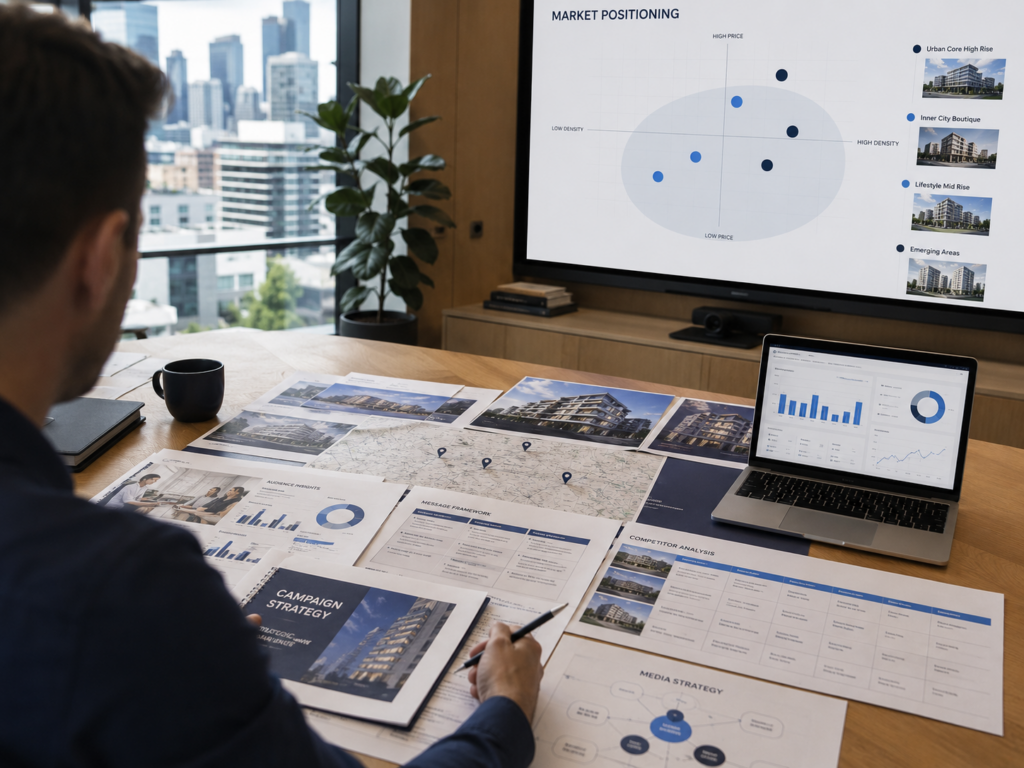

Most property marketing engagements are concentrated around launch. Colony Placemaker’s work begins earlier and continues longer — from the strategy and positioning decisions made before a project goes to market, through to the campaign oversight and optimisation work that keeps momentum through the final stage. That continuity is not a service model preference. It is what produces the consistency that makes campaigns perform.
The challenge with point-in-time marketing support is that it fragments the work. Strategy is commissioned separately from brand, brand is handed to a creative team with limited briefing, the campaign launches without a clear line back to the original positioning, and by the time the project reaches its final stage, the marketing has drifted significantly from the place story that should have been driving it throughout. We see this frequently when we pick up projects mid-campaign, and the cost of recovering that coherence is always higher than it would have been to build it in from the start.
Strategy and Positioning: The Work That Determines What Everything Else Can Do
We begin every project engagement with strategy. Before any brief is written for a brand, a name or a campaign, we want to understand what the project actually is — not just what it contains, but what it offers that nearby developments do not, who it is genuinely for, and what the market conditions are that the campaign will be working within. That understanding comes from research, from market analysis and from time spent with the project team, the site and the surrounding area.
The positioning we develop at this stage is the foundation for everything that follows. It determines the territory the brand will occupy, the audiences the campaign will prioritise and the messages that will be used to reach them. Getting it right before the brand is built is not a procedural preference — it is the difference between a campaign that is coherent from first release to final stage and one that has to be course-corrected at the point where it is most expensive to do so.
Lifecycle support: ongoing marketing engagement across all phases of a development project — from strategy and brand through to campaign management and final stage optimisation — rather than point-in-time project support.
The strategy phase also serves a practical coordination function within the project team. When the developer, the designer, the selling agent and the marketing team all understand the positioning clearly and have contributed to shaping it, the downstream briefing process becomes significantly more efficient. Misalignment at the strategy phase tends to produce rework at every stage that follows.
Creative Delivery and Campaign Management Across the Full Project Timeline
Our creative delivery is grounded in the strategy work that precedes it. The brand, the campaign concept and the content we produce are all expressions of the positioning we have developed — not independent creative decisions made in isolation from it. That connection is what allows the work to remain coherent across a project timeline that can span two, three or more years, through multiple campaign phases, changing market conditions and evolving project milestones.
Campaign management is an active, ongoing function in our engagements — not a monitoring brief. We oversee channel performance, manage agency and media relationships on behalf of the project, and make active recommendations about where spend should be redirected as the campaign evolves. When a channel is underperforming, we identify it early and adjust. When a new audience segment is responding at higher rates than anticipated, we move to capture that momentum rather than waiting for the next budget review.
This means the projects we are involved in through a full campaign lifecycle consistently maintain their momentum more effectively through the middle and final stages — the periods where campaigns most commonly lose direction and where the cost of declining enquiry is highest relative to the remaining sales task.
Maintaining Project Momentum Through Optimisation and Final Stage
Campaign optimisation is where the value of ongoing involvement becomes most visible. A team that has been with a project since strategy has context that a team brought in for optimisation alone cannot replicate — they understand what the project was originally positioned to deliver, where the campaign has performed against those intentions and what adjustments are consistent with the place story rather than opportunistic reactions to short-term data.
Final stage delivery is an area we take particular care with. The buyers who remain uncommitted at this point in a project’s sales process are often those who need the most considered engagement — they have been in the database longest, they have more questions and they require a different approach from the broad activation that drove early sales. We adjust the messaging, the channel mix and the contact cadence to reflect this, and we ensure that the project arrives at completion with its brand and positioning intact rather than diluted by late-stage discounting or inconsistent communication.
The projects we support through their full lifecycle consistently produce stronger outcomes at the final stage than those where we have been engaged for a specific phase only. That is not a coincidence. It is the compounded return on continuity.
Looking for a team to partner with across the full life of your project — from strategy to final stage?
See how Colony Placemaker provides integrated strategy, brand and campaign support for residential and mixed-use developments across Brisbane and SEQ.