
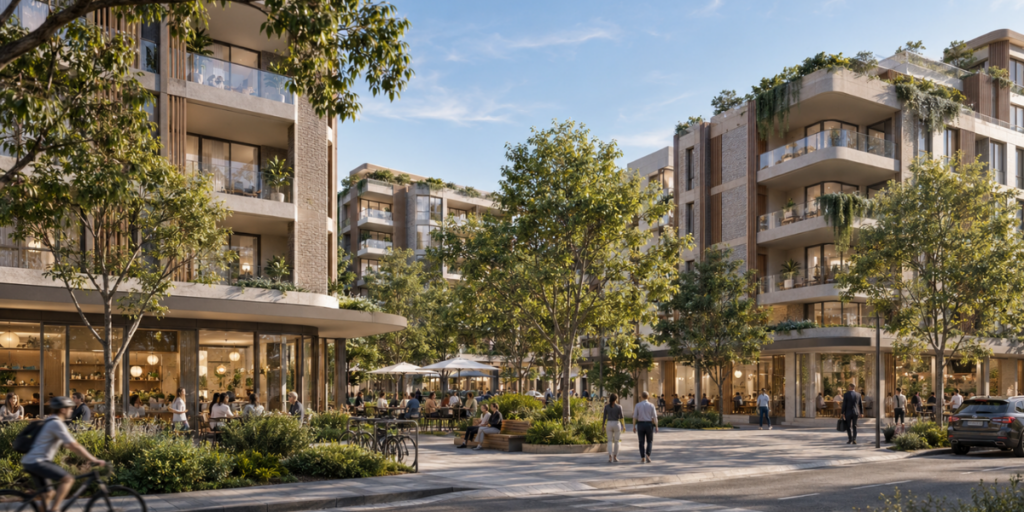
Place Vision for Property Development: Shaping the Future of Places
Most property developments begin with a brief. A site, a typology, a target market, a projected return. But the developments that perform most strongly over time tend to begin with something more foundational than that – a clear place vision that answers a question no financial model can: what kind of place is this, and why does it matter?
Place vision is not a tagline. It is not a mood board or a brand colour palette. It is a strategic position, a defined point of view about what a development is, who it is for, and how it intends to exist in the world over the long term. When that position is clear, everything downstream becomes easier: naming, brand identity, marketing communication, sales team alignment and community engagement all have a shared reference point.
In competitive property markets, place vision is increasingly the difference between a development that cuts through and one that blends in.
What a Place Vision Actually Is
A place vision is a clear, considered statement of what a development aspires to be, not just in terms of product, but in terms of experience, identity and community. It defines the emotional and functional qualities the place will deliver, and articulates why those qualities are meaningful to the people who will live, work or spend time there.
Done well, a place vision does several things simultaneously. It gives the development team internal clarity and a shared language. It gives the marketing and brand team a strategic anchor. And it gives buyers, tenants and stakeholders a compelling reason to engage before a single sod has been turned.
A strong place vision will typically address:
- the core identity of the place and the values it embodies,
- the audience it is designed for and the lifestyle it supports,
- the role it plays within its broader neighbourhood or precinct,
- and the qualities that distinguish it from competing projects in the market.
How Place Vision Shapes Brand and Marketing Outcomes
The relationship between place vision and brand strategy is direct and consequential. A project without a clearly defined place vision is a project where brand decisions get made on instinct or by default, none of which produces consistent or compelling results.
When place vision is established early, it becomes the brief that brand, naming, messaging and creative all respond to. It answers the questions that would otherwise slow down or fragment the process: What does this development stand for? What feeling should the campaign evoke? What kind of buyer are we speaking to, and what language will resonate with them?
Projects with a strong place vision tend to produce marketing that feels cohesive and intentional. Those without one tend to produce marketing that feels generic, interchangeable with dozens of other developments in the same postcode. The downstream effects include:
- stronger brand recall and differentiation in the market,
- a more consistent experience across website, sales collateral, social content and display,
- sales teams who can articulate the project’s story confidently and credibly,
- and a clearer foundation for stakeholder and community engagement.
Place vision does not replace creative judgment. But it gives creative judgment something solid to work from, which is the difference between a brand that feels considered and one that feels assembled.
Building a Place Vision: Where the Work Actually Happens
Creating a place vision is not a desk exercise. It requires engagement with the people who hold knowledge about the site, the market, the community and the opportunity, and it requires structured thinking to translate that knowledge into a coherent strategic position.
At Colony Placemaker, this work sits within our Insight and Strategy service and typically begins with discovery workshops and stakeholder engagement, a process designed to surface the assumptions, ambitions and constraints that exist across the developer, project teams and leadership. That input is then synthesised alongside market and competitor analysis to identify the position most likely to create genuine distinction.
The output is a clear, usable articulation of place vision that can be handed directly to brand, naming and creative teams as a brief, and used by the developer to make confident decisions at every stage of the project.
The key inputs that shape a strong place vision include:
- deep understanding of the site- its history, context, character and potential,
- competitor analysis to identify what the market already says and where the gaps exist,
- clarity about the target audience- their lifestyle, values and decision-making drivers,
- and alignment from key stakeholders on the principles the development will stand for.
Place vision is most powerful when it is agreed upon before the brand work begins. When developers attempt to establish place vision mid-campaign or retrospectively, after the brand has already launched, the cost is measured not just in rework, but in lost momentum, confused messaging and diluted market positioning.
The projects most likely to build strong market presence and sustain it through multiple stages, are those where the team agrees early on what kind of place they are creating, and has the discipline to protect that vision across every decision that follows.
Explore how Colony Placemaker helps developers build the strategic foundation for places that connect, perform and endure.